Every year, international universities spend significant budget flying to recruitment fairs across Asia, the Middle East, Latin America and Europe. Every year, they return home having met students who may or may not have the qualifications, language skills or financial capacity to enrol. There is a more efficient approach. And it has been sitting in the same place for years.
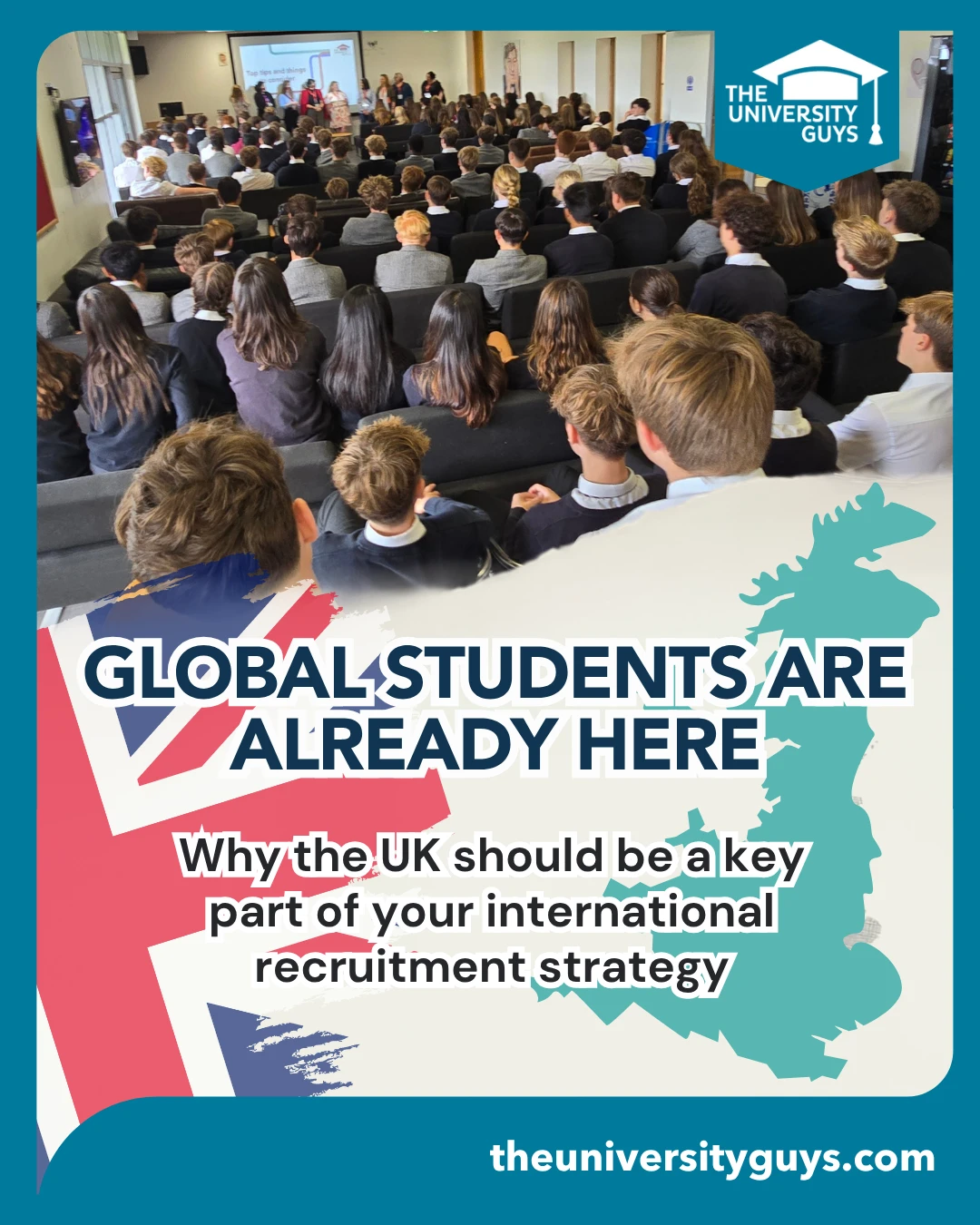
There are 57,214 non-UK pupils studying in UK independent schools right now. They come from Mainland China, Hong Kong, Germany, Spain, Japan, Nigeria, the Middle East, India, Ukraine and over fifty other countries. They are living, studying and making university decisions in one country, in English, at schools that trust the advisors who show up.
In short: the students you are trying to recruit are already here, in the UK.
The UK’s Independent Schools Council Census 2026, published this summer, is the most comprehensive annual data set on UK independent school pupils. Its headline figure – 526,611 pupils across 1,455 schools – tells part of the story. The international composition of those schools tells the rest.
Of the 57,214 non-UK pupils, 22,941 have parents living outside the UK entirely. These are families who made the decision to send their child to a UK boarding school from abroad – families who are already comfortable with distance, already invested in international education, and already thinking in terms of where to go next.
A further 34,273 non-UK pupils have parents resident in the UK. This group is equally significant. These are families who relocated to the UK and chose an independent school education for their children. Many of them are actively comparing UK university options with international alternatives.
The top nationalities in UK independent schools currently are Mainland China (10,207 pupils), Hong Kong (5,987), USA (5,078), Germany (2,967), France (2,475), Spain (2,108), Japan (1,400), Ukraine (1,734), India (1,932) and Nigeria (1,226). This is not a domestic market. It is a global market, concentrated in one country.
The concentration of these international students in the older year groups is particularly significant for university recruiters. ISC data shows that 55.7% of all pupils with parents overseas are in Years 12 and 13: the precise moment when university decisions are being made. When you visit a UK boarding school sixth form, you are meeting students at peak decision-making time, from families who have already demonstrated the financial capacity and mobility mindset that international university enrolment requires.
Average boarding fees in the UK are currently £14,980 per term – roughly £45,000 per year, before extras. Families making that investment over five or six years of secondary school are not families who will balk at international university fees. They are families who have already decided that the right education is worth paying for.
At schools we visit, present to and support, a sixth form group of 200 students might include pupils from 25 or 30 different countries. A single school visit can produce conversations with prospective students whose home countries would have required ten separate international recruitment trips to reach.
And, crucially, more of them are looking beyond the UK. The census data confirms what we see in schools every day: 7% of ISC university-bound pupils chose a university outside the UK last year. A decade ago, that figure was closer to 3.5%.
This is not a temporary fluctuation. It reflects a structural shift in how internationally mobile families are thinking about university. The UK higher education market is under pressure – larger cohorts, tighter resources, accommodation shortages, rising costs. At the same time, the range of international options that families know about and feel comfortable considering has expanded significantly. In 2012, fewer than 400 institutions worldwide attracted ISC pupils. That figure now stands at 635. The market is broadening, and it is broadening fast.
Some 59.2% of UK independent schools with Year 13 leavers sent at least one student to a university outside the UK last year. This is not a niche. International university consideration is mainstream in these schools, and the counsellors and heads of sixth form who shape those conversations are the most important people you can build relationships with.
The most popular non-UK destination for ISC leavers is the USA, accounting for 48.1% of those who study abroad. Spain is second at 8%, and IE University in Madrid is now the single most attended non-UK institution among ISC leavers. Bocconi ties with the University of Chicago.
These institutions are not winning because they are the most prestigious names in the room. They are winning because they did the work of being present, being known, and being trusted by the counsellors who make recommendations. IE University’s position at the top of the ISC destination table is the result of years of relationship-building in UK schools through a consistent presence on-the-ground, not a marketing campaign.
The institutions that will lead this market in five years are the ones building those relationships now.
This autumn, we are running three regional roadshows this autumn: Heart of England (27 September – 2 October), Metro London (8-13 November), and Southern England (22-27 November).
Each roadshow visits 15 or more schools across a distinct UK region, including boarding schools and leading day schools where international student populations are strong and counsellors are actively advising on overseas university options.
How can The University Guys support?
Our team at The University Guys specialises in bridging the gap between international higher education and UK schools. Through curated regional roadshows, strategic counselling support, and deep-rooted school relationships, we help universities build meaningful, long-term connections with high-potential applicants across the whole of the UK.
Not only do we plan full days of school visits and high-impact interactions, but we also take care of all logistics, including hotels, internal travel, and meals. This allows university representatives to be fully present and give their undivided attention to the schools, students, and families.
To learn more about how we connect global institutions with UK schools, consider our upcoming events and reach out to Sheena@theuniversityguys.com.